> For the complete documentation index, see [llms.txt](https://docs.fireboom.io/llms.txt). Markdown versions of documentation pages are available by appending `.md` to page URLs; this page is available as [Markdown](https://docs.fireboom.io/v1.0/ji-chu-ke-shi-hua-kai-fa/shen-fen-yan-zheng/yin-shi-mo-shi.md).
# 隐式模式
OIDC除了授权码模式,还有隐式模式,即基于token的登录。该模式常结合移动应用或 Web App 使用。
> OIDC 隐式模式不会返回授权码 code,而是直接将 `access_token` 和 `id_token` 通过 **URL hash** 发送到**回调地址前端**,**后端无法获取**到这里返回的值,因为 URL hash 不会被直接发送到后端。
## OIDC配置
我们仍以授权码模式中提到的这张图为例:
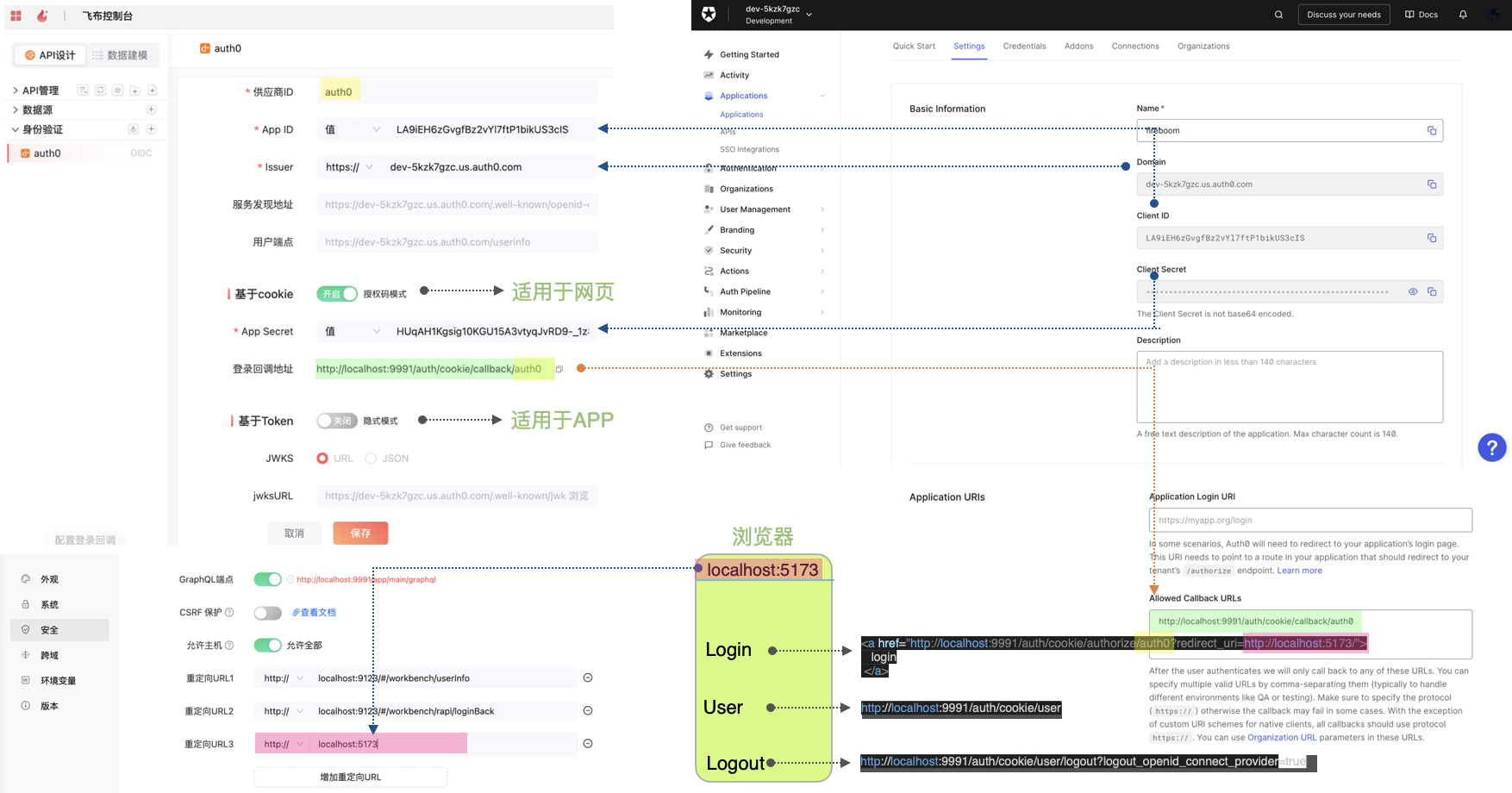 隐式模式不需要配置`App Secret`,但开启该模式后,需要保证`JWKS`可用,有两种指定方式:
* JWKS端点:
* JWKS JSON文件:
```json
{
"kty": "RSA",
"e": "AQAB",
"n": "1GBBv-QOtbNIvgJZqvW2nvIrNx6-YNKJAD3L3WspAcx1y-RYctI2RBb4k4GN0du8AH2UUf8wBywONHplYAw1djkWAztHgj4cc_WxqKvD1t5bNNjRW7I5EPA9ZEkFblIAxZVwhOPK5H8KLgiVaD7y9fPEks6sVhu2VUQKC0Qr85-0WJVzmXP3QH_1yLn1qRpkJtjCW1I4DPsB0TrQC6WBMy99Io8zECraueLrJFApuRx1H_MwgDwnt4VlYuaoqU17TyBUQWO077mUB-FFI-s0jALuPAUuNWHFFogTq2cbydaSfPcWQPjylYcLcIt-bBBdedLqsTk_0nTXPqREMFwexw",
"alg": "RS256",
"use": "sig",
"kid": "AUQR2TFiVexgvm0j0PrbZ3ofEz9R2eG7qvEJP9Ua2f0"
}
```
其中,JWKS URL可以从服务发现地址中获取。
```http
https://dev-5kzk7gzc.us.auth0.com/.well-known/openid-configuration
```
## OIDC使用
### 获取Token
获取Token有两种方式:id\_token Flow和登录接口。
{% hint style="info" %} 区别是:id\_token Flow需要依赖OIDC的登录页,而登录接口获取可以自定义登录页!
{% endhint %}
#### id\_token Flow
以Authing为例,构建如下 id\_token flow URL。
{% code overflow="wrap" %}
```http
# 授权地址,与授权码模式类似
https://xxxx.authing.cn/oidc/auth?
# 客户端ID,即应用ID
client_id=644512df9e360e3f7a40e1e4&
# 重定向URL,授权完成后,跳转的页面
redirect_uri=https://example.com&
scope=openid%20profile&
# 授权类型,注意与授权码模式不同,非常重要
response_type=id_token%20token&
state=6223573295&nonce=1831289
```
{% endcode %}
访问后,进入登录页,输入账号密码登录。
登录成功后,将跳转到如下链接:
```http
https://example.com/#
# 授权令牌
access_token=part1.part2.part3&
# 令牌类型,Bearer
token_type=Bearer&
# 令牌过期时间
expires_in=1209600&
scope=openid%20profile&
# id令牌
id_token=part1.part2.part3&
state=6223573295
```
将 `access_token` 保存到客户端使用,例如:`local storage`。
#### 登录接口
下面是Authing用账户密码登录的HTTP请求,详情可参考[Authing的SDK](https://docs.authing.cn/v2/reference/sdk-for-node/authentication/AuthenticationClient.html#%E4%BD%BF%E7%94%A8%E7%94%A8%E6%88%B7%E5%90%8D%E7%99%BB%E5%BD%95)。
```bash
curl --location --request POST 'https://xxxx.authing.cn/api/v3/signin' \
# 用户池ID
--header 'x-authing-userpool-id: 64452248da5930463241789f' \
# 应用ID
--header 'x-authing-app-id: 644513df9e260e3f7a10e3e4' \
--header 'Content-Type: application/json' \
--header 'Accept: */*' \
--header 'Connection: keep-alive' \
--data-raw '{
"connection":"PASSWORD", # 登录模式
"passwordPayload":{
"password":"123456", # 密码
"phone":"18189156130" # 账户
}
}'
```
```json
{
"statusCode": 200,
"message": "",
"data": {
"scope": "profile openid tenant_id",
"token_type": "Bearer",
"access_token": "part1.part2.part3", // 保存使用
"expires_in": 1209600,
"id_token": "part1.part2.part3"
}
}
```
{% hint style="info" %}
不同的OIDC供应商,实现不同!
{% endhint %}
Fireboom官方也开源一个简单的OIDC服务,当前仅支持隐式模式,详情请查看:[fb-oidc](https://github.com/fireboomio/fb-oidc)
### 使用Token
假设,有如下OPERATION,使用 `@fromClaim` 指令修饰,意思是根据当前登录用户的UID,查询待做事项列表:
{% code title="FromClaim.graphql" %}
```graphql
query MyQuery($uid: String! @fromClaim(name: USERID)) {
todo_findManyTodo(where: {uid: {equals: $uid}}) {
id
title
}
}
```
{% endcode %}
其将被编译为如下REST API,请求如下:
```bash
curl -X GET "http://localhost:9991/operations/FromClaim" \
# 添加以下请求头
--header 'Authorization: Bearer ' \
-H "accept: application/json" \
```
```json
{
"data": {
"todo_findUniqueClaim": {
"email": "test@example.com",
"emailVerified": false,
"location": "",
"name": "test@example.com",
"nickname": "test",
"provider": "auth0",
"roles": null,
"userId": "auth0|637b4ab0c0cb508c49de7cf3"
}
}
}
```
## 工作原理
接下来,我们学习下OIDC协议隐式模式的工作原理。
### 正常流程
隐式模式不需要配置`App Secret`,但开启该模式后,需要保证`JWKS`可用,有两种指定方式:
* JWKS端点:
* JWKS JSON文件:
```json
{
"kty": "RSA",
"e": "AQAB",
"n": "1GBBv-QOtbNIvgJZqvW2nvIrNx6-YNKJAD3L3WspAcx1y-RYctI2RBb4k4GN0du8AH2UUf8wBywONHplYAw1djkWAztHgj4cc_WxqKvD1t5bNNjRW7I5EPA9ZEkFblIAxZVwhOPK5H8KLgiVaD7y9fPEks6sVhu2VUQKC0Qr85-0WJVzmXP3QH_1yLn1qRpkJtjCW1I4DPsB0TrQC6WBMy99Io8zECraueLrJFApuRx1H_MwgDwnt4VlYuaoqU17TyBUQWO077mUB-FFI-s0jALuPAUuNWHFFogTq2cbydaSfPcWQPjylYcLcIt-bBBdedLqsTk_0nTXPqREMFwexw",
"alg": "RS256",
"use": "sig",
"kid": "AUQR2TFiVexgvm0j0PrbZ3ofEz9R2eG7qvEJP9Ua2f0"
}
```
其中,JWKS URL可以从服务发现地址中获取。
```http
https://dev-5kzk7gzc.us.auth0.com/.well-known/openid-configuration
```
## OIDC使用
### 获取Token
获取Token有两种方式:id\_token Flow和登录接口。
{% hint style="info" %} 区别是:id\_token Flow需要依赖OIDC的登录页,而登录接口获取可以自定义登录页!
{% endhint %}
#### id\_token Flow
以Authing为例,构建如下 id\_token flow URL。
{% code overflow="wrap" %}
```http
# 授权地址,与授权码模式类似
https://xxxx.authing.cn/oidc/auth?
# 客户端ID,即应用ID
client_id=644512df9e360e3f7a40e1e4&
# 重定向URL,授权完成后,跳转的页面
redirect_uri=https://example.com&
scope=openid%20profile&
# 授权类型,注意与授权码模式不同,非常重要
response_type=id_token%20token&
state=6223573295&nonce=1831289
```
{% endcode %}
访问后,进入登录页,输入账号密码登录。
登录成功后,将跳转到如下链接:
```http
https://example.com/#
# 授权令牌
access_token=part1.part2.part3&
# 令牌类型,Bearer
token_type=Bearer&
# 令牌过期时间
expires_in=1209600&
scope=openid%20profile&
# id令牌
id_token=part1.part2.part3&
state=6223573295
```
将 `access_token` 保存到客户端使用,例如:`local storage`。
#### 登录接口
下面是Authing用账户密码登录的HTTP请求,详情可参考[Authing的SDK](https://docs.authing.cn/v2/reference/sdk-for-node/authentication/AuthenticationClient.html#%E4%BD%BF%E7%94%A8%E7%94%A8%E6%88%B7%E5%90%8D%E7%99%BB%E5%BD%95)。
```bash
curl --location --request POST 'https://xxxx.authing.cn/api/v3/signin' \
# 用户池ID
--header 'x-authing-userpool-id: 64452248da5930463241789f' \
# 应用ID
--header 'x-authing-app-id: 644513df9e260e3f7a10e3e4' \
--header 'Content-Type: application/json' \
--header 'Accept: */*' \
--header 'Connection: keep-alive' \
--data-raw '{
"connection":"PASSWORD", # 登录模式
"passwordPayload":{
"password":"123456", # 密码
"phone":"18189156130" # 账户
}
}'
```
```json
{
"statusCode": 200,
"message": "",
"data": {
"scope": "profile openid tenant_id",
"token_type": "Bearer",
"access_token": "part1.part2.part3", // 保存使用
"expires_in": 1209600,
"id_token": "part1.part2.part3"
}
}
```
{% hint style="info" %}
不同的OIDC供应商,实现不同!
{% endhint %}
Fireboom官方也开源一个简单的OIDC服务,当前仅支持隐式模式,详情请查看:[fb-oidc](https://github.com/fireboomio/fb-oidc)
### 使用Token
假设,有如下OPERATION,使用 `@fromClaim` 指令修饰,意思是根据当前登录用户的UID,查询待做事项列表:
{% code title="FromClaim.graphql" %}
```graphql
query MyQuery($uid: String! @fromClaim(name: USERID)) {
todo_findManyTodo(where: {uid: {equals: $uid}}) {
id
title
}
}
```
{% endcode %}
其将被编译为如下REST API,请求如下:
```bash
curl -X GET "http://localhost:9991/operations/FromClaim" \
# 添加以下请求头
--header 'Authorization: Bearer ' \
-H "accept: application/json" \
```
```json
{
"data": {
"todo_findUniqueClaim": {
"email": "test@example.com",
"emailVerified": false,
"location": "",
"name": "test@example.com",
"nickname": "test",
"provider": "auth0",
"roles": null,
"userId": "auth0|637b4ab0c0cb508c49de7cf3"
}
}
}
```
## 工作原理
接下来,我们学习下OIDC协议隐式模式的工作原理。
### 正常流程
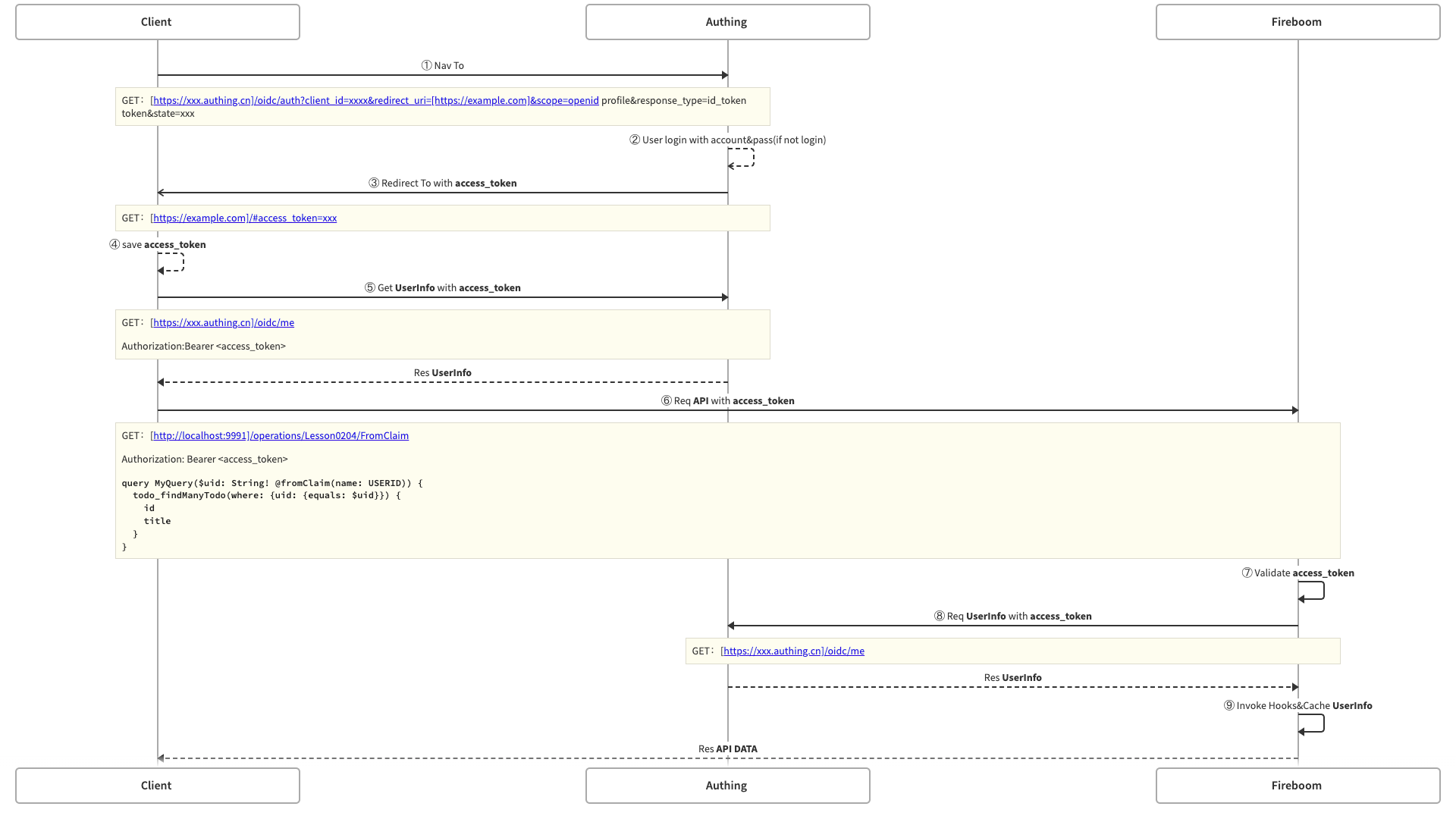
隐式模式时序图
该时序图有3个主体:客户端、Fireboom服务器、OIDC供应商 authing。
#### 1.客户端到OIDC(Authing)
在客户端构造下述URL,跳转到Authing授权端点。
{% code overflow="wrap" %}
```http
# Authing 授权端点
https://xxx.authing.cn/oidc/auth?
# 客户端ID,用于区分是哪个应用
client_id=xxxx&
# 重定向URL,当前客户端的前端页面(不是Fireboom的地址)
redirect_uri=[https://example.com]&
# 授权范围
scope=openid profile&
# 授权类型,这是与授权码模式的区别之处
response_type=id_token token&
state=xxx
```
{% endcode %}
#### 2.跳转到OIDC登录页
若用户未登录,则跳转到authing的登录页,支持账户密码、手机验证码,甚至是社交登录,如微信、QQ等。

#### 3.OIDC跳转到客户端
登录成功后,authing再跳转到客户端回调地址上,同时携带授权码`access_token`和`id_token`。
和授权码模式不同这里拿到的不是code,且此时未经过飞布服务。
```http
https://example.com/#
# 授权令牌
access_token=part1.part2.part3&
# 令牌类型,Bearer
token_type=Bearer&
# 令牌过期时间
expires_in=1209600&
scope=openid%20profile&
# id令牌
id_token=part1.part2.part3&
state=6223573295
```
#### 4.客户端保存令牌
客户端保存`access_token`及`expires_in` ,供下次使用,一般存储到`local storage`中。
#### 5.客户端获取OIDC用户
客户端使用`access_token`,访问OIDC的用户信息端点,获得当前用户。
```bash
curl --location --request GET 'https://xxx.authing.cn/oidc/me' \
--header 'Authorization: Bearer ' \
--header 'Accept: */*' \
```
```json
{
"name": "anson",
"given_name": null,
"middle_name": null,
"family_name": null,
"nickname": "18189156130",
"preferred_username": "18189156130",
"profile": null,
"picture": null,
"website": null,
"birthdate": "2023-06-29T12:47:00.173Z",
"gender": "male",
"zoneinfo": null,
"locale": null,
"updated_at": "2023-08-09T09:07:37.988Z",
"tenant_id": "",
"sub": "645b472d9df8868fe52074d6"
}
```
总结一下,1-5步骤,都不需要飞布服务参与,完全可以由客户端和OIDC服务器完成。
和授权码模式最大的不同是,隐式模式不需要client secret,也不需要使用 code 换 token,更无需请求 token 端点,access\_token 和 id\_token 会直接从授权端点返回。
#### 6.客户端请求Fireboom API
客户端请求Fireboom API时,携带如下请求头 ,示例见 [#shi-yong-token](#shi-yong-token "mention")
```http
Authorization: Bearer
```
#### 7.Fireboom校验令牌
Fireboom 根据 [配置的JWK公钥](#oidc-pei-zhi) 验签`access_token`。该过程不需要OIDC服务参与,因此也意味着OIDC中的Token黑名单不会生效。需要使用Fireboom的 [OPERATION钩子](/v1.0/jin-jie-gou-zi-ji-zhi/operation-gou-zi.md#wang-guan-gou-zi) 自行实现黑名单。
#### 8.客户端获取Fireboom用户
若Fireboom服务未缓存用户信息,则会用`access_token`请求OIDC用户端点,获得用户,同 [#5.-ke-hu-duan-huo-qu-oidc-yong-hu](#5.-ke-hu-duan-huo-qu-oidc-yong-hu "mention")。
#### 9.Fireboom调用钩子
Fireboom 调用授权钩子,在钩子中修改用户信息,返回后,由Fireboom 缓存用户信息,详情见 [身份验证钩子](/v1.0/jin-jie-gou-zi-ji-zhi/shen-fen-yan-zheng-gou-zi.md),并返回用户信息到客户端。
### 简化流程
刚刚介绍的,无论是授权码模式还是隐式模式都需要使用OIDC原生的登录页。那如果想自定义登录页,又该如何做呢?
其实只要基于隐式模式稍作调整,就能支持该需求。我们知道,隐式模式的本质是获得`access_token`,然后用其请求接口。
那如果OIDC服务提供了根据账户密码获得`accest_token`的接口,是不是就可以供我们在自己编写的界面中直接调用了呢?
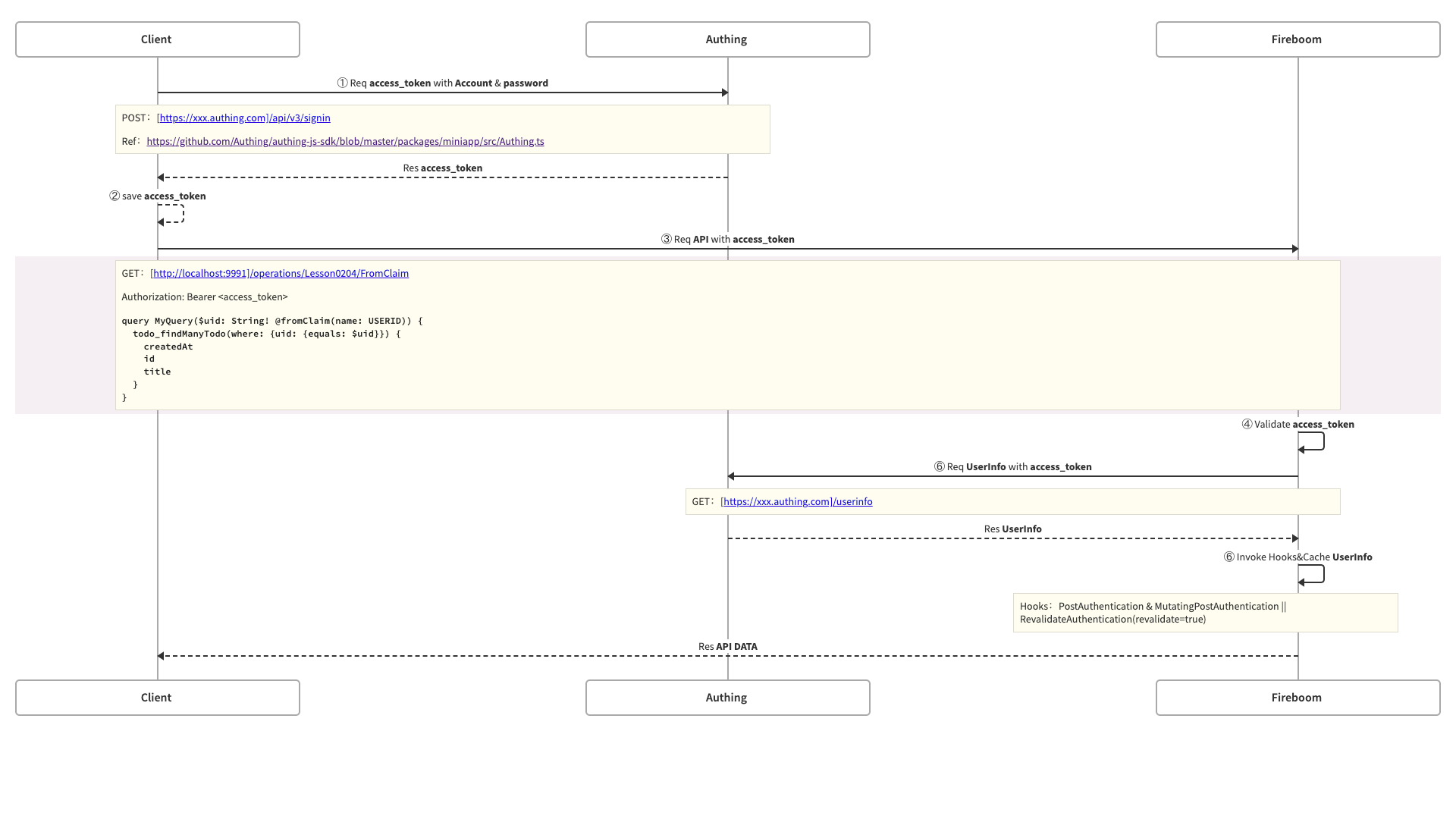
隐式模式时序图-简化版
我们仍以authing为例,上述流程图就展示了该过程。
#### 1.调用登录接口
通过post请求,输入账户、密码或手机号、验证码,获得`acces_token`。不同OIDC供应商有对应实现,详情可参考其文档。例如前文中提到的 [#deng-lu-jie-kou](#deng-lu-jie-kou "mention")
#### 2.客户端存储令牌
客户端存储 `acces_token`,供后续使用。
其他流程没有变化,同 [#zheng-chang-liu-cheng](#zheng-chang-liu-cheng "mention") 的步骤6-9。
### 总结
总结一下,隐式模式的流程更加简洁。
由于其不依赖cookie,所以适用范围更广,不仅支持浏览器,也能支持类似微信小程序或者原生APP。
但缺点是安全性不足,因为其直接将`access_token`泄露给了客户端。